In modern healthcare environments, the mobile ward round cart has become an essential tool that connects clinical workflow efficiency with patient experience. A well-designed ward round cart must not only carry a variety of medical devices but also maintain stability during frequent movement, maneuver flexibly in confined spaces, and reduce operator fatigue during prolonged use. This article examines the application value and core advantages of mobile ward round carts in medical settings.
The mobile ward round cart is a foundational component of daily ward rounds. Physicians move the cart between patient rooms; the monitor mount on top supports an electronic medical record (EMR) terminal or portable ultrasound device, while the work surface holds stethoscopes, medications, and patient record folders. The cart's height-adjustable design allows clinical staff to work comfortably whether standing or sitting, reducing the physical strain associated with repeated bending or reaching.
.png "14_05_01 (7).png")
In ICU settings, ward round carts are commonly used alongside patient monitors, ventilators, and infusion pumps. The aluminum alloy frame provides substantial load-bearing capacity, and the storage space beneath the work surface accommodates cables and small consumables, preventing cable tangling that could hinder operational efficiency. The silent caster design also minimizes disturbance to patients during nighttime rounds.
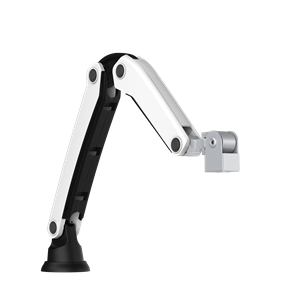
With the growing adoption of portable ultrasound devices, mobile ward round carts are increasingly used in radiology and emergency departments. The monitor mount offers a wide height-adjustment range to accommodate various screen sizes, and the adjustable arm angle enables operators to obtain an optimal viewing angle from different body positions. The height-adjustable work surface, combined with the cart's inherent mobility, makes bedside imaging procedures more flexible.
During surgical preparation and anesthesia support, the cart needs to carry anesthesia machine accessories, medication storage boxes, and monitoring equipment. The work surface material must be wipe-resistant and corrosion-resistant; the use of ABS engineering plastic makes the surface easy to clean and disinfect, meeting the infection control requirements of operating room environments.
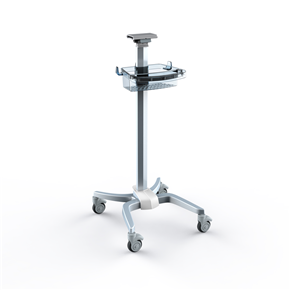
The base dimensions of a mobile ward round cart directly affect overall stability. Taking the ST-C1 as an example, its base measures 480 mm × 440 mm, with a four-point layout providing a broad support area that resists tipping during pushing and pulling. The aluminum alloy base, combined with a powder-coated finish, ensures structural strength while reducing overall weight; at 30 kg, the cart can be easily maneuvered by a single staff member.
The wide-stance chassis design offers another advantage — even when carrying a monitor or heavy equipment, the center of gravity remains within the support footprint, avoiding the "top-heavy" problem common with traditional narrow-base carts.
The work surface height can be adjusted between 839 mm and 1,139 mm, with a lift stroke of 300 mm. This range accommodates operators of different heights and supports both standing work and seated documentation.
From an ergonomic perspective, when the work surface height is close to the operator's elbow height, the arms hang naturally and shoulder and neck muscle load is reduced. The adjustable surface allows clinical staff of varying heights to find their optimal working position, helping to lower the risk of occupational musculoskeletal strain over long-term use.

The ST-C1's chassis uses aluminum alloy with powder coating; the vertical column is also powder-coated aluminum alloy; and the tray is made of ABS engineering plastic. This combination addresses multiple usage requirements:
- Aluminum alloy frame: Lighter than stainless steel and more corrosion-resistant than carbon steel; the powder coating further enhances surface abrasion resistance and aesthetics.
- ABS tray: Smooth surface for easy cleaning, with reasonable impact resistance at a controlled cost; suitable for medical environments requiring frequent wiping and disinfection.
- Medical-grade silent casters: The 4-inch-diameter casters roll smoothly even under the cart's full 30 kg weight; the silent material reduces noise during movement, which is particularly valuable in ward and ICU environments.
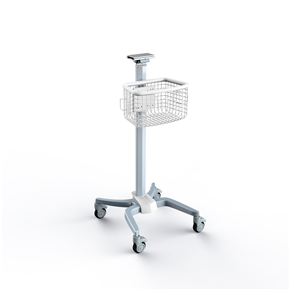
The ST-C1's design reflects a modular approach. The monitor mount height can be adjusted between 1,114 mm and 1,414 mm, accommodating a range of screen sizes. The pull-out tray at the front of the work surface extends the operating area, and the optional side storage basket (measuring 214 mm × 150 mm × 332 mm) provides additional storage space.
The significance of modular design lies in its flexibility: different departments can select accessories based on actual needs — radiology can add a monitor mount and ultrasound device holder, anesthesiology can configure a medication storage module, and general ward rounds require only the base configuration. This adaptability extends the cart's service life and reduces equipment replacement costs for hospitals.
Hospital corridors, ward passageways, and elevator spaces have limited dimensions, and a cart's overall size and turning flexibility directly affect the user experience. The ST-C1's overall dimensions of 550 mm × 440 mm allow it to pass through most standard ward doors and hospital corridors. Four swivel casters enable the cart to turn in place, making it easy to operate in the tight spaces around hospital beds.
The handle design on the work surface serves both pushing and positioning needs — when pushing, the handle allows even force application; when stationary, the handle can serve as an extended support point for the work surface.
Suitable for daily ward rounds in general patient rooms. Includes: base cart frame, adjustable work surface, and standard handle. Meets the needs of medical record documentation and basic diagnostic procedures.
Suitable for mobile ultrasound and imaging diagnosis scenarios. Adds a monitor mount and ultrasound device fixation module on top of the standard configuration. The mount's height and angle adjustability allow operators to flexibly adjust the viewing angle based on patient positioning.
Suitable for ICU and emergency scenarios. Adds a side storage basket, cable management module, and additional device fixation mounts on top of the standard configuration. The storage basket holds consumables and cables to keep the work surface organized, while the cable management module prevents tangling between devices.
Suitable for comprehensive scenarios requiring multiple devices, such as anesthesia support and surgical preparation. Optional modules include a printer base, keyboard tray, and multi-tier shelving, maximizing the cart's load-bearing capacity.

The quality of a medical cart is directly reflected in the following dimensions:
Structural Safety: The relationship between base dimensions and the cart's overall center of gravity determines its anti-tipping capability. The welding quality and surface treatment of the aluminum alloy frame affect long-term reliability.
Operational Convenience: The smoothness of the height-adjustment mechanism, the rolling performance of the casters, and the comfort of the handle grip — these details accumulate into a significant experience difference across hundreds of push-pull operations each day.
Environmental Adaptation: The disinfectant resistance of materials, the ease of surface cleaning, and noise control during movement all affect whether a cart can genuinely integrate into a hospital's infection control system and daily operations.
Visual Harmony: The light gray and white color scheme allows the cart to blend with the visual style of most medical environments without appearing out of place — an aspect that is frequently considered for medical equipment.
The application of mobile ward round carts in medical settings has evolved from simple item transport tools into comprehensive platforms that carry multiple medical devices and improve clinical workflow efficiency. From chassis structure and work surface ergonomics to material selection and modular expansion, every design detail influences the cart's performance in real medical environments. Stone Wisdom Technology, in its practice with mobile ward round carts, emphasizes the balance between structural stability and operational convenience, offering flexible and configurable mobility solutions for different departments through the combination of aluminum alloy frames, adjustable work surfaces, and medical-grade silent casters. As medical informatization and portable devices continue to advance, the integration level and functional expansion potential of mobile ward round carts will continue to grow.






 WeChat
 Online Service
