Article Source:Stone Wisdom Technology | Author:Stone Wisdom Technology | Time:2026-11-17
The ST-DT2 is a dual-deck medical cart from Stone Wisdom Technology, designed for ward nursing, outpatient treatment and examination support. It uses a central-column lift with a 300 mm stroke; the two decks move together and keep a fixed spacing of 287 mm. The worktop measures 445×420 mm (550×420 mm including the handle), the base measures 480×440 mm, and the cart runs on 4-inch silent medical casters.
The second deck is not there to add storage capacity. It separates two categories of items: frequently used supplies and devices sit on the upper deck, while the main working surface and consumables sit on the lower deck, with a pull-out tray beneath it for small items. One round trip between the nurses' station and a patient room can then cover preparation, the procedure itself and charting, without a detour back to the treatment room for supplies.
The sections below read the cart against four practical criteria: passage clearance, working height, storage zoning and mobility.
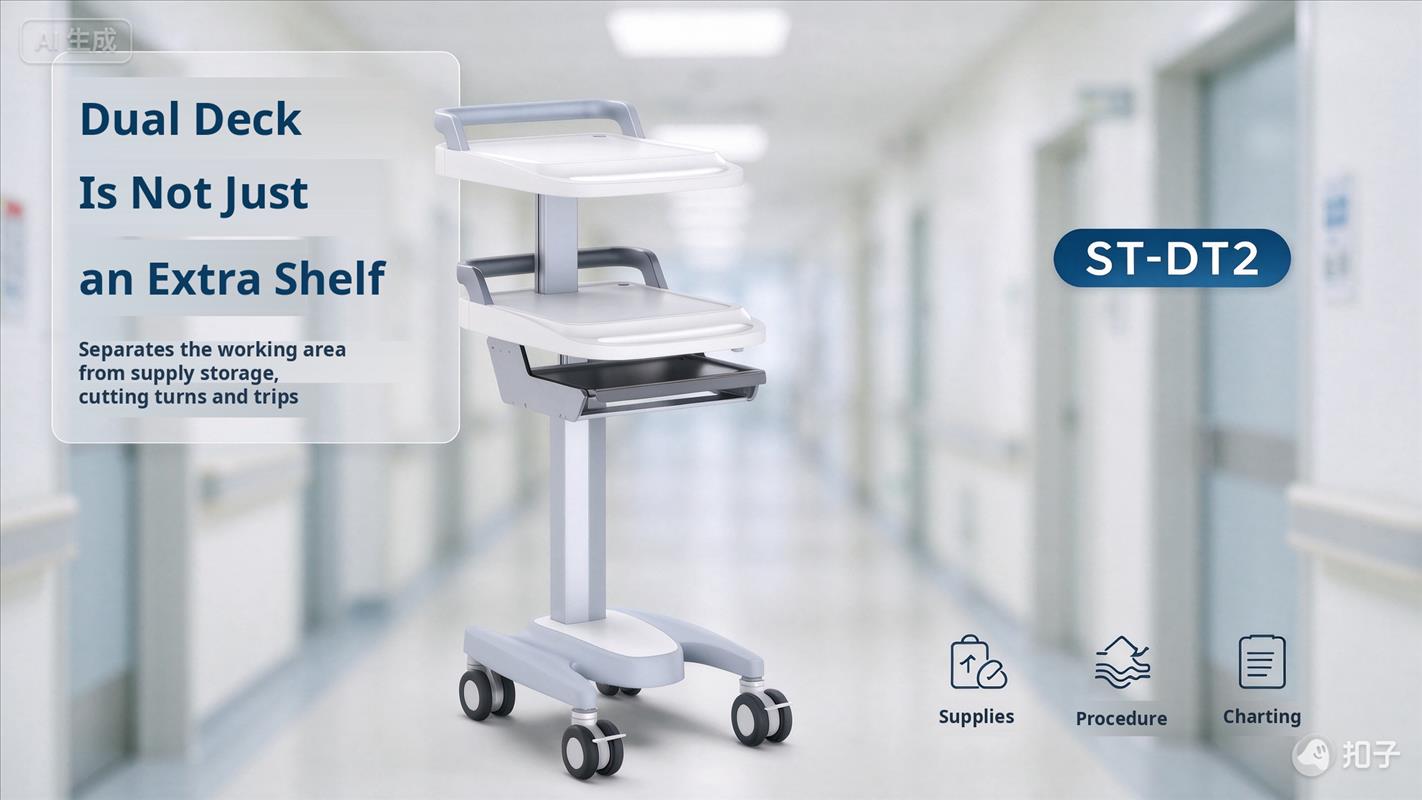
On a single-deck cart, the working surface typically holds a treatment tray, alcohol swabs, IV catheters, charting forms and a blood pressure monitor at the same time. Retrieval order breaks down because everything shares one plane, and finding a small item means moving the whole tray.
The constraint is not capacity but zoning. When items of different use frequency and different cleanliness levels are stored together, every retrieval becomes a small act of re-sorting.
A dual-deck layout splits items by frequency: the upper deck carries items used most often — treatment supplies for the shift, monitoring devices, charting forms; the lower deck serves as the main working surface for the treatment tray and consumables; the pull-out tray below it holds small items. Clean and contaminated items can be kept on separate levels, so the workflow stays one-directional.
For high-intensity, continuous work such as morning care rounds, every detour on the route costs time. What the structure removes in detours shows up in how much a shift can complete.
| Item | Specification |
|---|
| Base dimensions | 480×440 mm |
| Worktop dimensions | 445×420 mm (550×420 mm including handle) |
| First (lower) worktop height | 839–1139 mm |
| Second (upper) worktop height | 1126–1426 mm |
| Overall dimensions | 550×440×(1205–1505) mm |
| Lifting stroke | 300 mm |
| Casters | Silent medical casters, 4 in (approx. 101 mm) OD |
| Materials | ABS engineering plastic worktops; aluminum column with powder-coated finish |
Standard configuration shown. Optional and custom configurations are defined by the product configuration sheet.
A specification sheet is only a list of numbers until each number is tied to a specific action. The six figures below come from the product data sheet; the criteria used to judge them come from requirements that recur in cart procurement — passage clearance is a function of overall dimensions against door width, and stability is a function of base footprint, centre of gravity and braking.
One point worth stating plainly: in public medical device standards databases, a general technical standard titled simply "medical cart" is not commonly listed. In practice these products are governed by manufacturer enterprise standards, registration or filing requirements, and individual hospital procurement specifications. For selection purposes, matching specifications is more useful than memorising standard numbers.
A narrow base is the hard constraint in ward settings. At 480 mm the cart passes through most standard ward doors and the gap alongside a bed, so staff can move around the bedside without repositioning the bed first. Measure the door before comparing base dimensions.
With the handle, the worktop measures 550 mm — 70 mm wider than the base. Lift cars, corridor corners and storage passages should be assessed against overall dimensions; using the base alone underestimates the footprint.
This surface accommodates a standard laptop plus a treatment tray with room left for retrieval. Raised edges around the perimeter keep items from sliding during transport and contain spills before they reach the floor.
This range covers seated charting and bedside procedures. When a nurse sits to write, the elbow sits close to worktop height, so the shoulders and neck are not held in a raised position for long periods.
Deck spacing is fixed at 287 mm, and both decks travel together through a 300 mm stroke. Because the spacing never changes, adjusting height does not require re-planning what goes where; the layout stays consistent and becomes a shared habit across shifts, which also reduces handover explanation.
Four inches is approximately 101 mm, a common specification for medical carts. In hospital procurement specifications for carts, 4-inch silent swivel casters appear repeatedly as a requirement, and some documents specify that two of them must be braked.
Larger wheels roll more easily over thresholds, tile joints and carpet seams; silent tread reduces rolling noise at night and in ICU environments. With brakes on all four casters, the cart stays put when the worktop is loaded during a procedure.
Ward morning care rounds — Upper deck: blood pressure monitor, charting forms and supplies for the shift. Lower deck: treatment tray and IV catheter consumables. Pull-out tray: swabs, tape and other small items. Retrieval paths stay fixed.
Outpatient dressing and treatment — Upper deck holds dressing supplies; the lower deck takes temporary collection of used and waste materials, keeping clean and contaminated items on separate levels and the workflow one-directional.
Endoscopy and ultrasound support — The upper deck can carry an equipment or monitor mount (optional); the lower deck holds gel, probe cleaning supplies and report forms, reducing trips out of the examination room.
Health screening and community outreach — The narrow footprint simplifies loading and stairwell transport, and the two decks can split registration from sampling to shorten set-up time on site.
Materials and cleaning — The column is aluminum with a powder-coated finish, and the worktops are ABS engineering plastic. Surfaces are flat with no long seams, and tolerate routine wiping with standard hospital disinfectants. Rounded corners reduce impact injuries during bedside work.
Centre of gravity and stability — The central-column lift places the column at the geometric centre of the base, keeping the centre of gravity near the middle of the support area. Loaded worktops are therefore less likely to produce a top-heavy offset.
Lift operation — The 300 mm stroke covers the transition between standing and seated work, and height adjustment needs no secondary deck locking, which supports continuous use across shifts.
The ST-DT2 accepts optional equipment mounts and storage accessories; the exact list is defined by the product configuration sheet. Stone Wisdom Technology can advise on worktop height ranges, accessory combinations and caster configurations for a given project, so procurement teams can build a complete technical description for tenders or configuration filings.
Q1: Which departments is the ST-DT2 suited to?
Departments where items fall into two categories and routes are relatively long — ward nursing, outpatient dressing, endoscopy centres, ultrasound and health screening. Where a department only moves a single device, a single-deck cart is lighter and simpler.
Q2: How much heavier is a dual-deck cart than a single-deck one, and does that affect pushing?
With an additional deck, a second handle and the supporting structure, kerb weight is usually higher than a single-deck cart of the same class. The difference depends on worktop material, column construction and accessories, and varies considerably between models. What staff actually feel is driven by caster diameter and bearings: on level floors, a 4-inch dual-deck cart is not noticeably harder to push than a single-deck cart; on ramps, thresholds and carpet, the weight difference becomes apparent. This is also why dual-deck carts suit fixed wards better than frequent inter-floor transport.
Q3: Is the 839–1426 mm height range sufficient?
It depends on the department's dominant working posture. For seated charting, the lower limit of the first deck (839 mm) matters most; for standing work, the upper limit of the second deck (1426 mm) matters most. Both decks move together, so one adjustment covers both postures.
Q4: Will a 550 mm wide cart pass through a standard ward door?
Most standard ward doors have a clear opening above 800 mm, leaving ample margin for a 550 mm cart. For older buildings, converted spaces or isolation rooms, measure the clear opening and threshold height before finalising the configuration.
Q5: How should the worktops and column be cleaned?
ABS worktops and a powder-coated aluminum column can be wiped with standard hospital disinfectants; avoid prolonged contact with aggressive solvents. Drying surfaces after cleaning extends the service life of the coating.
Q6: Dual-deck or single-deck?
Look at how many item types a single procedure involves. More than six categories, or a need to separate clean from contaminated items, points to a dual-deck cart; one device plus a small amount of consumables points to a single-deck cart.
Shenzhen Stone Wisdom Technology Co., Ltd. was founded in 2015 and focuses on the development, manufacturing and sale of medical carts and related accessories. The range covers nursing carts, mobile diagnostic carts, endoscopy carts and ventilator carts, along with medical arms, mounting clamps and equipment wall mounts. The company holds ISO 9001 quality management system certification and CE certification, and its products are sold in more than 20 countries and regions.
With the ST-DT2, the trade-offs Stone Wisdom Technology made are straightforward: a narrower base, a stable deck spacing, and a lift that feels natural to operate. The specifications themselves are not complicated — but each one maps to a specific action at the point of care.
For the full ST-DT2 specification sheet, configuration list or a scenario-based recommendation, submit a request through the Contact Us page, or reach out to your regional sales engineer for technical documentation.






 WeChat
 Online Service
